
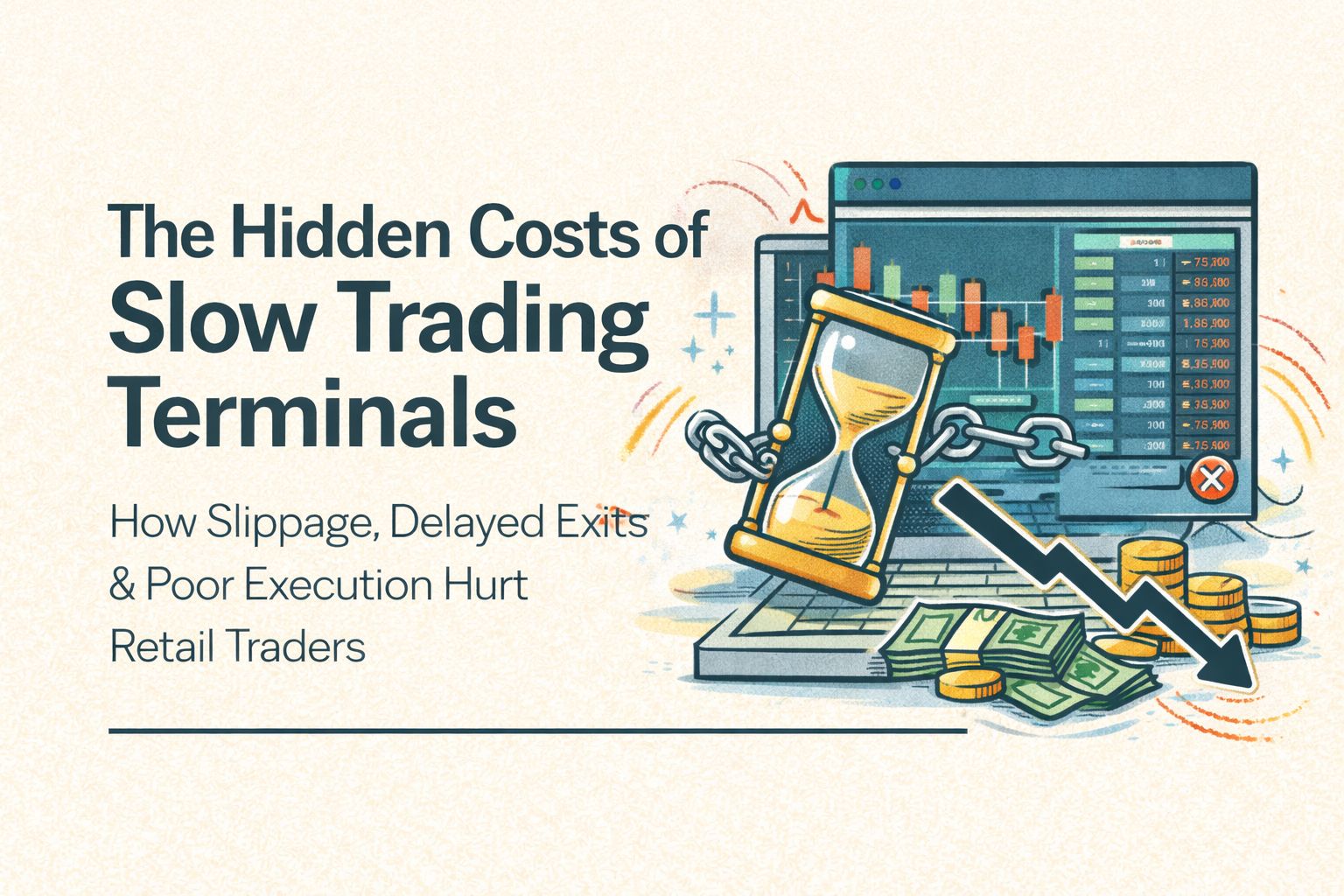
The Hidden Costs of Slow Trading Terminals: How Slippage, Delayed Exits & Poor Execution Hurt Retail Traders
Dhruva G
AuthorPublished December 24, 2025
The Hidden Costs of Slow Terminals: Slippage, Delayed Exits, and Emotional Losses
Most traders obsess over strategy design such as strike selection, timing, indicator combinations, volatility filters. Yet, profits rarely disappear because of strategy flaws. They slip away through something simple and far more damaging: slow execution.
A hesitation of two seconds.
A frozen screen during a spike.
A delayed exit when volatility expands.
An order that fills a few points away from where you expected.
These are not “trading mistakes.”
They are terminal failures and retail traders pay the price for them every day.
This is where the conversation needs to shift.
Because in modern index-option markets, the real edge is no longer just strategy logic; it is execution quality. And execution quality is shaped almost entirely by the speed, design, and intelligence of the terminal you place your orders on.
Where Retail Traders Lose Money Without Realizing It
The average retail trading platform was never designed for high-speed, weekly-expiry environments. They were designed for broad use like equity delivery, mutual funds, casual intraday trading.
Index options on weekly expiries, however, run on a different clock.
A market order can move 3-8 points instantly.
A spike can reverse a profitable position into a loss within a second.
Liquidity can vanish and reappear without warning.
What does this create?
Slippage you never accounted for
Late exits that destroy MTM
The emotional spiral that follows a poor fill
Strategy drift when execution deviates from testing assumptions
Losses that feel “irrational,” but aren’t
Slippage becomes a silent tax.
Delay becomes the real drawdown.
Emotion becomes the hidden execution cost.
And none of these show up on a back test chart.
Slippage: The Silent Drain on Retail P&L
Slippage is not just a matter of “bad fills.”
It reflects everything that goes wrong between your intention and the market’s response.
Most retail platforms treat market orders as blind commands.
The system hits whatever liquidity exists at the moment, even if the best available price is far outside your expectation.
This gap between your intended exit and your actual execution is the single biggest reason retail MTM behaves worse than retail strategy logic.
Delayed Exits: The Most Expensive Form of Hesitation
Every trader has experienced it:
A candle expands.
You want to cut the position.
The order takes too long to load.
The terminal stutters.
You wait for confirmation.
By the time your exit hits the exchange, the loss is twice what you accepted.
Slow terminals do not just delay execution; they distort decision-making.
Because when exits lag then you:
Widen your stop-loss out of frustration
Jump back into trades impulsively
Lose discipline after a bad fill
Change your strategy mid-day
Stop trusting your system
And once confidence erodes, trading becomes reactionary.
How Emotional Losses Begin With Execution, Not Psychology
Trading psychology books often blame emotions for losses: fear, greed, hesitation.
But most emotional spirals start with something else: a trader who did everything right, only to be let down by slow or inconsistent execution.
A good entry that fills poorly.
A profitable position that exits late.
A stop-loss that does not trigger at the intended zone.
These experiences convince traders that “the market is against them,” creating emotional pressure that has nothing to do with their own discipline and everything to do with the tools they’re forced to use.
This is where execution technology becomes more than convenience.
It becomes part of risk management.
Slippage Protection: The Missing Layer in Retail Trading
This is the point where the conversation shifts from problems to solutions.
Most broker terminals supply basic order placement. They do not attempt to manage slippage or protect fill quality. But modern index trading requires a system that understands how spreads behave, how liquidity shifts, and how to avoid extreme fills during spikes.
The Trado Terminal introduces a protection layer built specifically for this environment.
Instead of sending a market order blindly into the orderbook, it manages execution to prevent extreme or unintended fills.
This is not cosmetic.
It directly impacts:
MTM consistency
Strategy reliability
Expected vs. actual exits
Capital protection during volatility
By reducing the gap between intention and execution, slippage protection repairs the biggest distortion in retail P&L.
Protecting the Part of Trading Most Platforms Ignore
The Trado approach treats execution not as a mechanical process but as a core pillar of trading performance.
Slippage protection sits alongside other structural tools for disciplined execution:
One-click cancel & close during volatility
MTM-based stop-loss and target exits
Auto-trailing MTM protection
Index-driven entry and exit triggers
The common thread across all of them: protecting traders from the hidden costs that traditional terminals overlook.
Because the real danger is rarely the strategy.
It is the seconds lost during panic, the price gaps you didn’t intend, the emotional decisions that follow and the slow tools that cause them.
Execution Quality Is the New Edge
Retail traders underestimate how much money they lose to slow tools.
Not through obvious losses, but through:
inconsistent fills
widened losses
eroded discipline
missed exits
broken strategy assumptions
Upgrading strategy without upgrading execution technology is like tuning an engine but ignoring the brakes and steering.
A high-quality strategy deserves a high-quality terminal, one that protects execution, enforces discipline, and reduces silent losses.
Because in today’s market, the difference between a winning trader and a struggling one is often measured not in ideas, but in milliseconds.
Experience a terminal built around execution accuracy, slippage protection, and real intraday discipline.
Explore the Trado Terminal → https://www.trado.trade
Sign up for updates
TRADO is a Software as a Service (SaaS) Company & your gateway to seamless and empowered trading experience. We specialize in crafting innovative solutions to enhance the journey of traders. Built by Skilled IITians & Experienced Traders, combines cutting-edge technology with user-friendly interfaces, ensuring that you trade with efficiency, accuracy, and confidence.
© 2026 Windigotrade Pvt Ltd. All rights reserved.
Charts are powered by TradingView